adjective
homologous
hoh-MAH-luh-gus/həʊˈmɑːləɡəs/
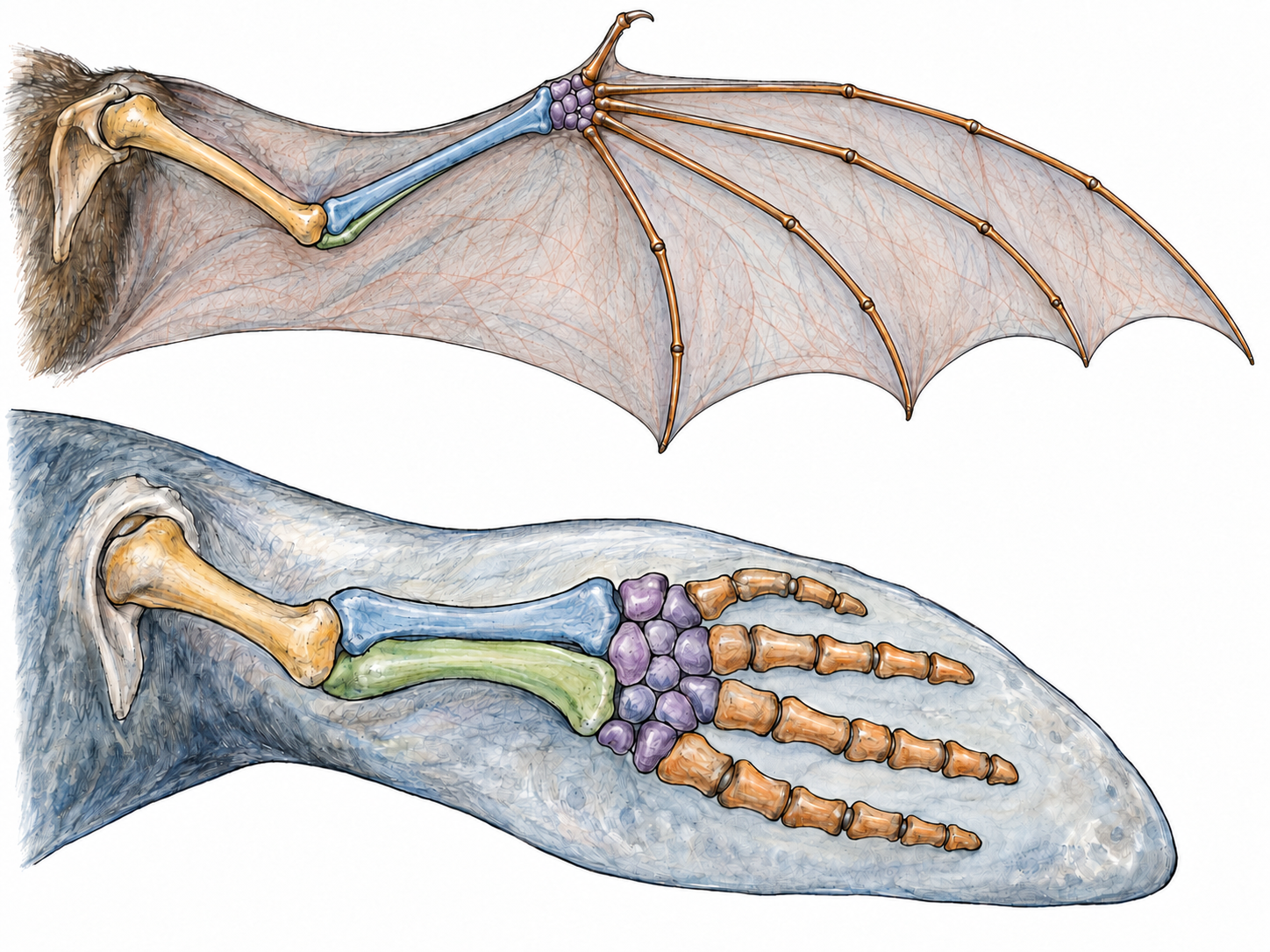
Matching in underlying structure, origin, or relationship.
The bat's wing and whale's flipper contain homologous bones arranged in a shared pattern.
Etymology
“Same” plus “relation” gave a Greek adjective meaning “agreeing.” That idea of agreement underlies corresponding structures or positions, including similarities attributed to shared ancestry.
In context
Labia majora, two flaps. Guess what, if you have a Y chromosome, your labia major zips up. What? It does. It zips up closed and forms the scrotum. These are homologous structures.
More examples
- Homologous chromosomes carry the same genes but may have different versions.
- Cactus spines are homologous to the leaves of other plants.
- Homologous sides of similar triangles have proportional lengths.
Forms
homologous
homology noun — Correspondence based on shared structure or origin.
Similar words
- analogous
- Similar in function, but not necessarily in evolutionary origin.
- corresponding
- Matching in position or role, without necessarily sharing ancestry.