noun
accelerator
ak-SEL-uh-ray-ter/əkˈseləreɪtər/
Something that increases the speed of motion or progress.
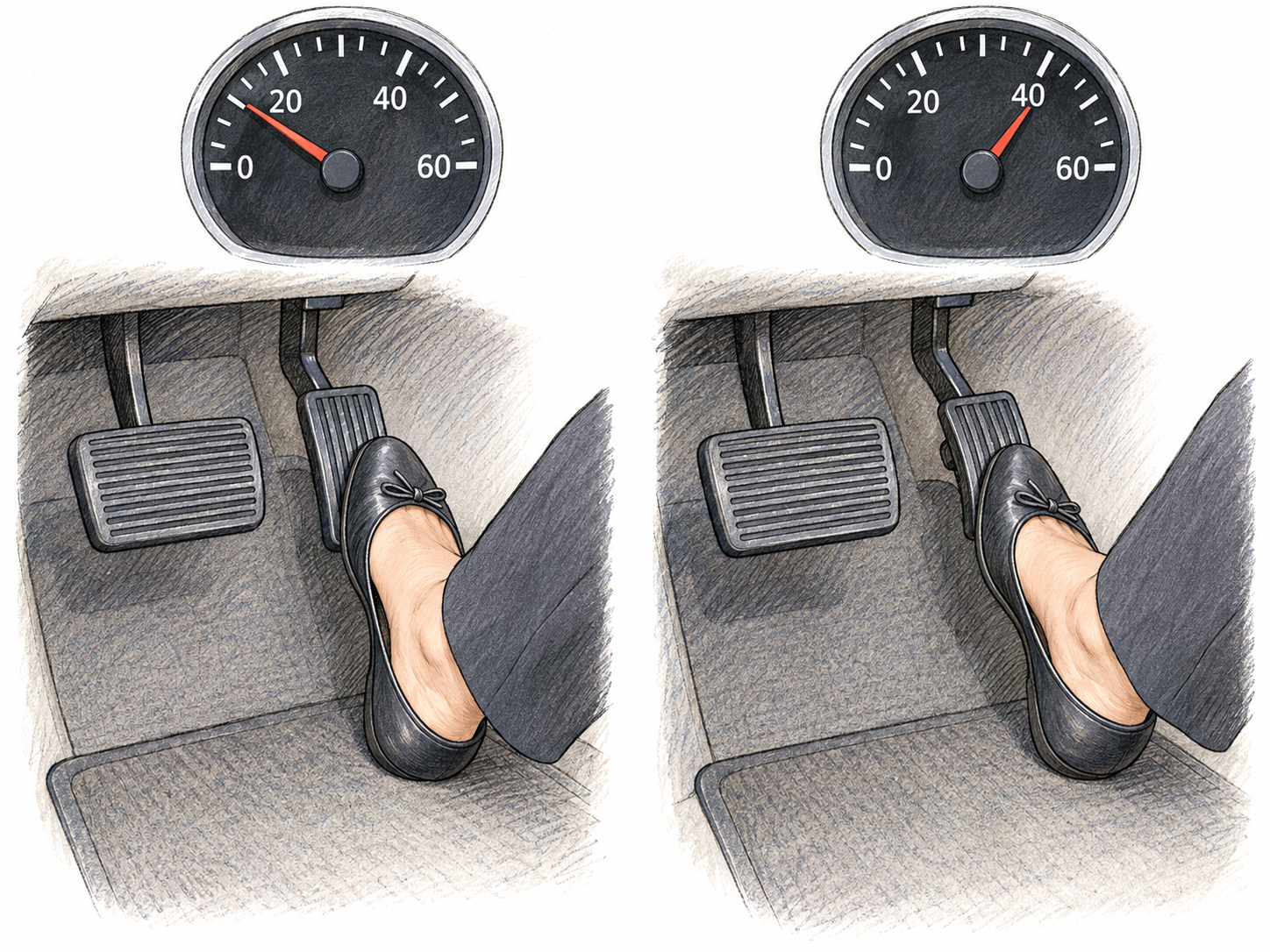
The driver presses the accelerator farther down, and the car gains speed.
Etymology
Built on the idea of making something swift, an accelerator was a “hastener.” That role extends naturally to a device or mechanism that makes motion or activity faster.
In context
we depress the accelerator pedal some non-zero amount the car would then accelerate to a constant speed
More examples
- The driver takes her foot off the accelerator.
- The program serves as an accelerator for young businesses.
- Magnets guide particles around the circular accelerator.
Forms
accelerator · accelerators
acceleration noun — A change in velocity over time.
beam noun — A directed stream of particles or radiation.
Similar words
- particle accelerator
- Full technical name, explicitly identifying the particles being accelerated.
- atom smasher
- Informal term, often emphasizing high-energy collisions in physics experiments.