DictionaryRoot: con-
Latin

con-

together, with; sometimes thoroughly

Forms

  • con-
  • com- — Used before certain consonants, especially b, p, and m.
  • col- — The final consonant changed before l.
  • cor- — The final consonant changed before r.
  • co- — The final consonant was lost in some combinations.

Origin

From Latin cum, “with,” and an older form com-.

Note

Togetherness could extend to completeness. Not every word containing this prefix retains an obvious “with” meaning.

11 / 108
noun

concept

KAHN-sept/ˈkɑːnsept/

An idea or mental model of something.

The different chairs share a basic form that represents the concept of a chair.
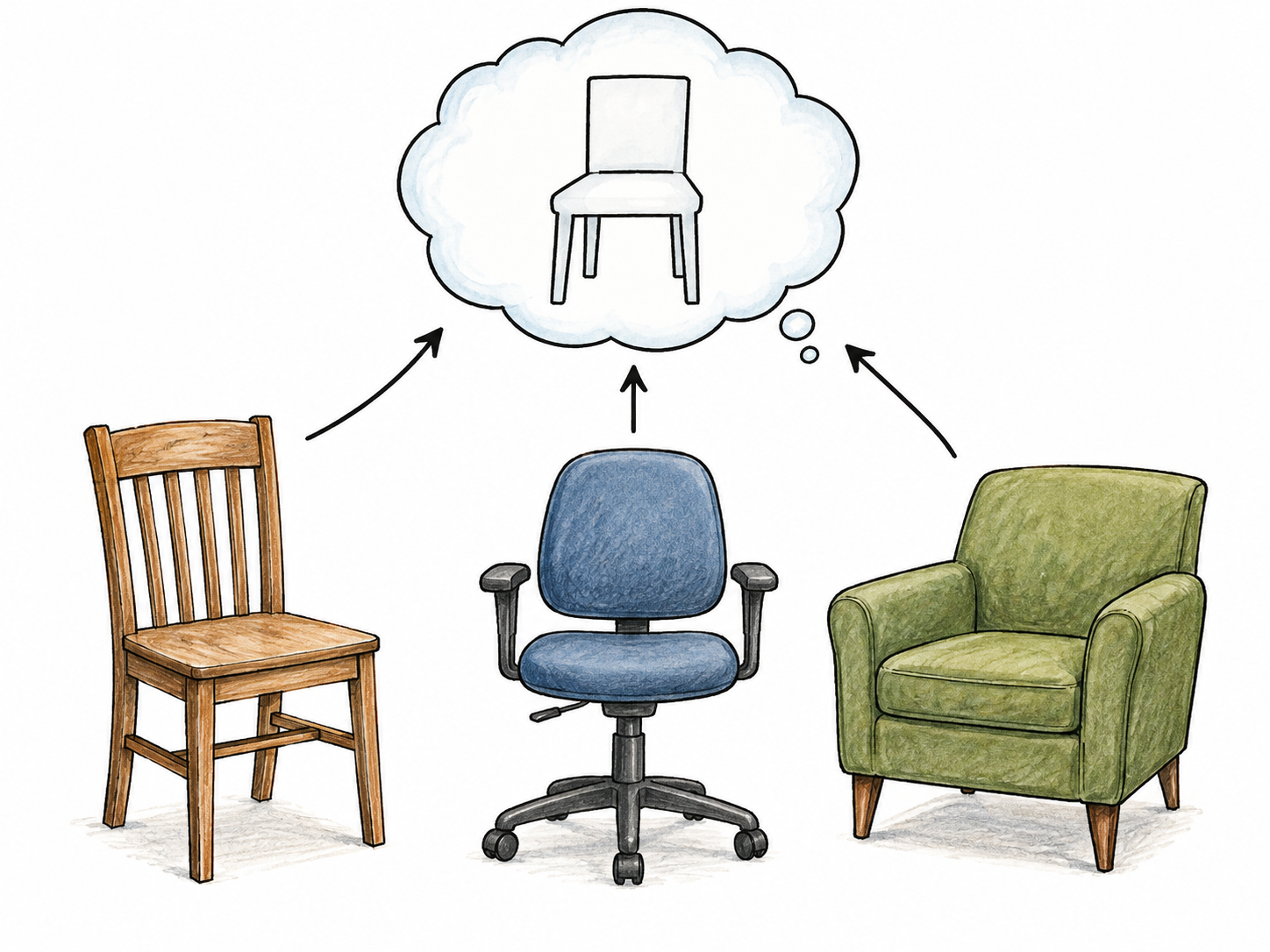
Three different chairs feed via small arrows into one simplified chair outline inside thought bubble, shared mental category rather than specific chair; natural ink object drawings, no words.
Etymology

From “take,” with con- perhaps adding emphasis, the underlying verb meant “take in and hold.” A concept is thus something conceived or formed in the mind, rather than physically taken in.

In context

Math and Science19:43
the concept of energy and I know that most everybody here has an idea of energy
01 - Introduction to Physics, Part 1 (Force, Motion & Energy) - Online Physics Course

More examples

  • Young children gradually develop a concept of time.
  • The architect sketches a new concept for the library.
  • These two concepts help explain how markets work.

Forms

concept · concepts

conceptual adjective — Relating to ideas rather than concrete details.

Similar words

idea
Broader term for any thought, suggestion, or possible plan.
notion
Often a less developed or less firmly held idea.