DictionaryRoot: con-
Latin

con-

together, with; sometimes thoroughly

Forms

  • con-
  • com- — Used before certain consonants, especially b, p, and m.
  • col- — The final consonant changed before l.
  • cor- — The final consonant changed before r.
  • co- — The final consonant was lost in some combinations.

Origin

From Latin cum, “with,” and an older form com-.

Note

Togetherness could extend to completeness. Not every word containing this prefix retains an obvious “with” meaning.

71 / 108
noun

construction

kun-STRUK-shun/kənˈstrʌkʃn/

The building of an organized whole from parts.

The crew uses a crane during construction of the brick house.
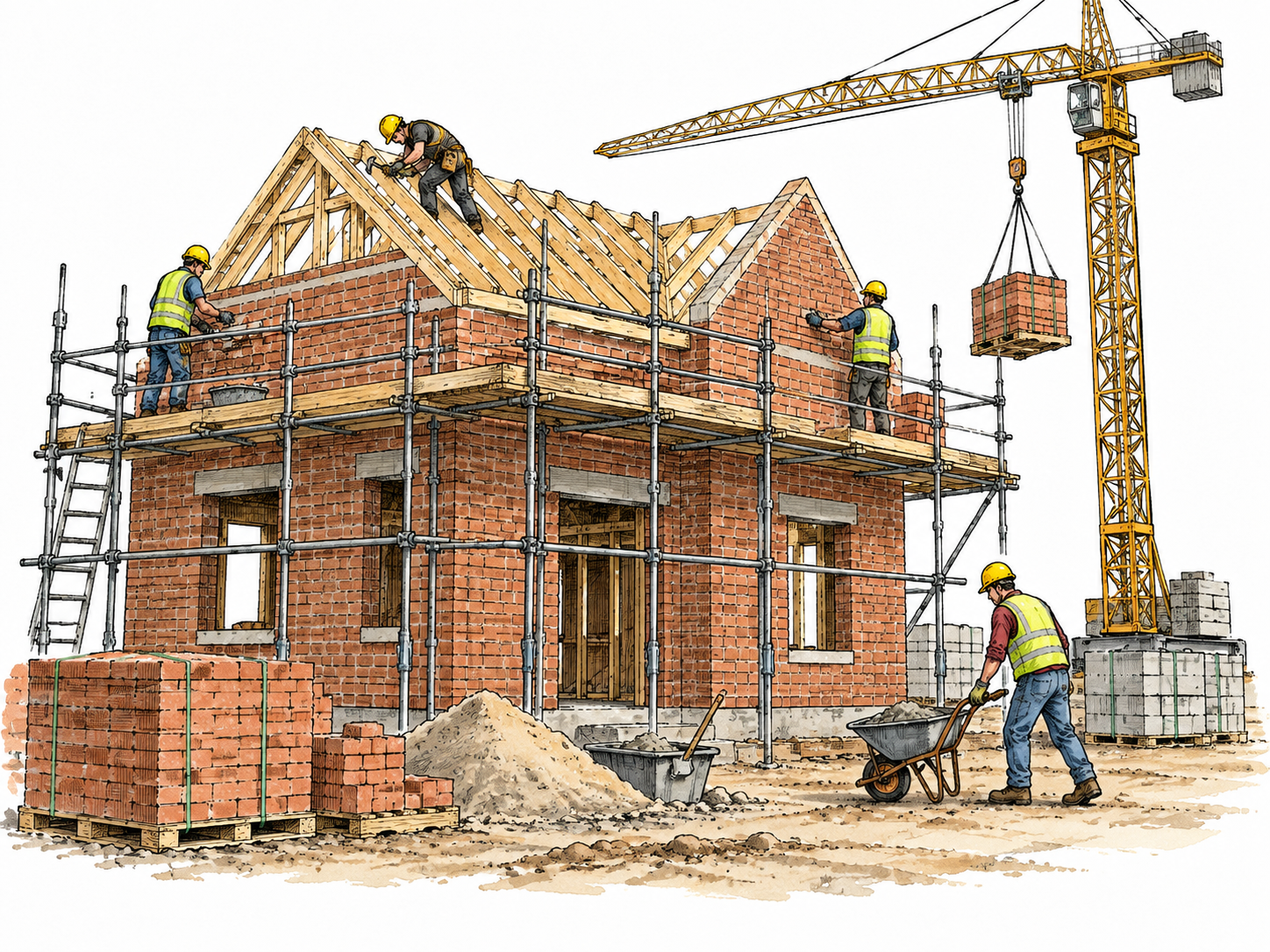
Construction crew building a brick house with scaffold and crane.
Etymology

Piling things together supplies the underlying image, and the noun ending names the activity. In this sense, construction is the process of assembling materials into a building or other structure.

In context

Tim Fairley332:29
construction is the process we go through to create the design to deliver the project in accordance with the drawings and specifications.
The COMPLETE Guide to Construction Project Management

More examples

  • The model's construction requires patience and a steady hand.
  • The chair's solid construction helps it withstand daily use.
  • We practice several sentence constructions in writing class.
  • The judge gives the law a narrow construction.

Forms

construction · constructions

construct verb — To build or assemble something from parts.

Similar words

assembly
Emphasizes fitting separate parts together into a finished whole.
building
Usually refers to creating physical structures, especially houses or offices.
formation
Emphasizes something taking shape, sometimes without deliberate human effort.