DictionaryRoot: -io
Latin

-io

an action, process, or result

Forms

  • -io
  • -ion- — The longer form used before Latin endings.
  • -ion — The form carried into many English nouns.

Origin

An old Latin noun ending, inherited from earlier Indo-European word formation.

Note

The ending can name both an activity and what that activity produces.

180 / 371
noun

fission

FISH-un/ˈfɪʃn/

The splitting of a whole into two or more separate parts.

The diagram shows a nucleus splitting through fission.
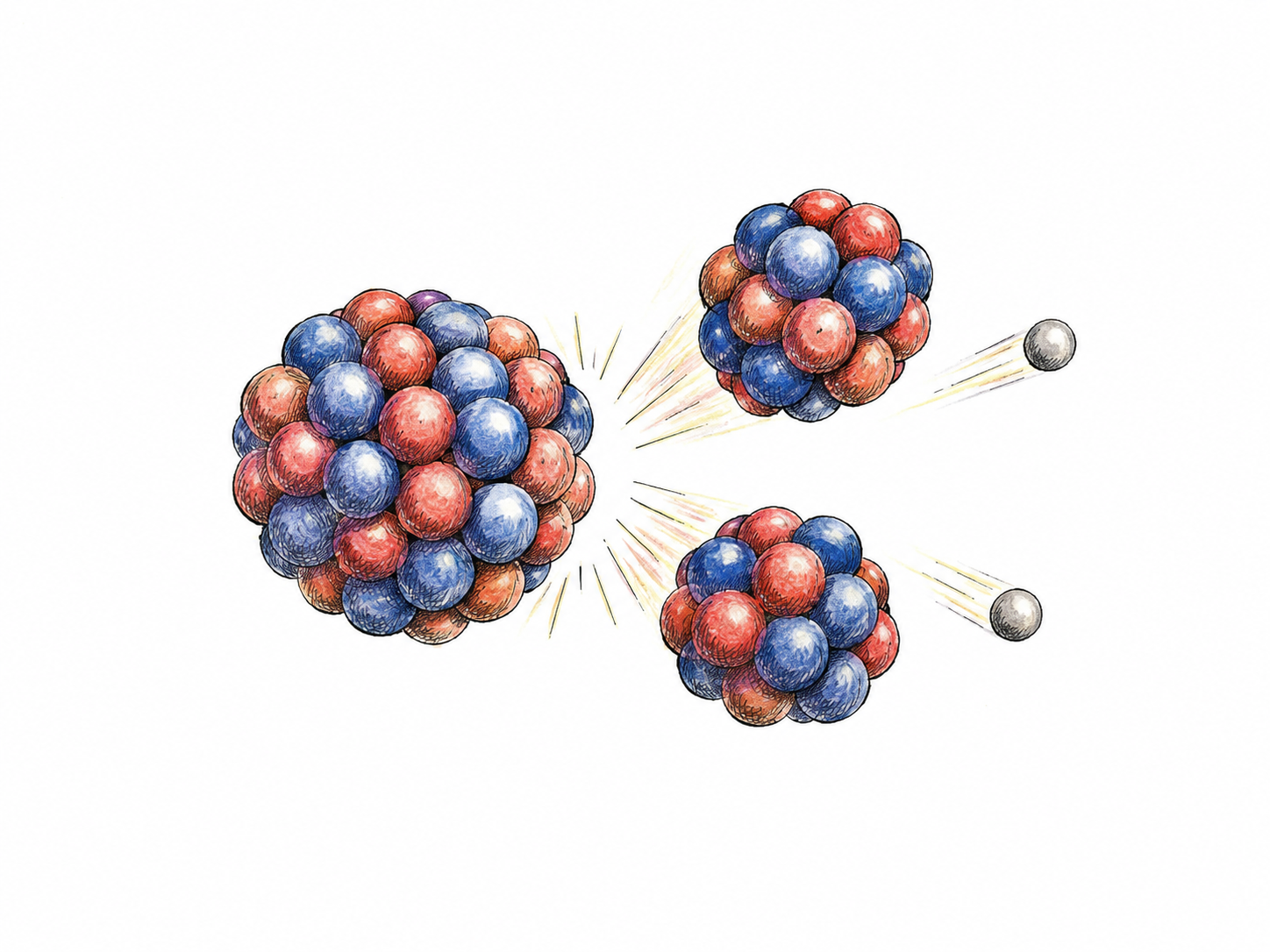
Conceptual physics vignette shows one atomic nucleus separating into exactly two smaller clusters of red and blue spheres with a small gap opening between them, two tiny neutral spheres departing; no apparatus, formula, weapon or chain reaction.
Etymology

Fission names a process of splitting. It first described the division of a cell or organism in English, before being applied to the splitting of an atomic nucleus.

In context

Ron Hipschman20:38
fission of the uranium atom happens when it's hit with a stray Neutron the extra Neutron destabilizes the nucleus which then splits into two smaller lighter nuclei
Gadolinium - Tales from the Periodic Table

More examples

  • The cell reproduced by binary fission.
  • The laboratory recorded the fission of a single cell into two.
  • The model showed the nucleus undergoing fission.

Forms

fission · fissions

Similar words

fusion
Fusion joins things together; fission splits them apart.
division
Division is the broad term for separating into parts; fission is especially used in physics and biology.