DictionaryRoot: -alis
Latin

-alis

of, relating to

Forms

  • -alis
  • -aris — Latin variant especially used when the stem already contained l, avoiding a repeated l sound.
  • -al — English ending borrowed through French or directly from Latin.
  • -ar — English ending continuing Latin -aris.

Origin

An older Latin adjective-forming suffix; its more remote ancestry is uncertain.

Note

Expresses a relationship without specifying its kind: material, place, purpose, and other connections are possible.

69 / 291
adjective / noun

equilateral

ee-kwuh-LAT-er-uhl/ˌiːkwəˈlætərəl/

Having all sides equal in length, or a triangle with this property.

Each side of an equilateral triangle has the same length.
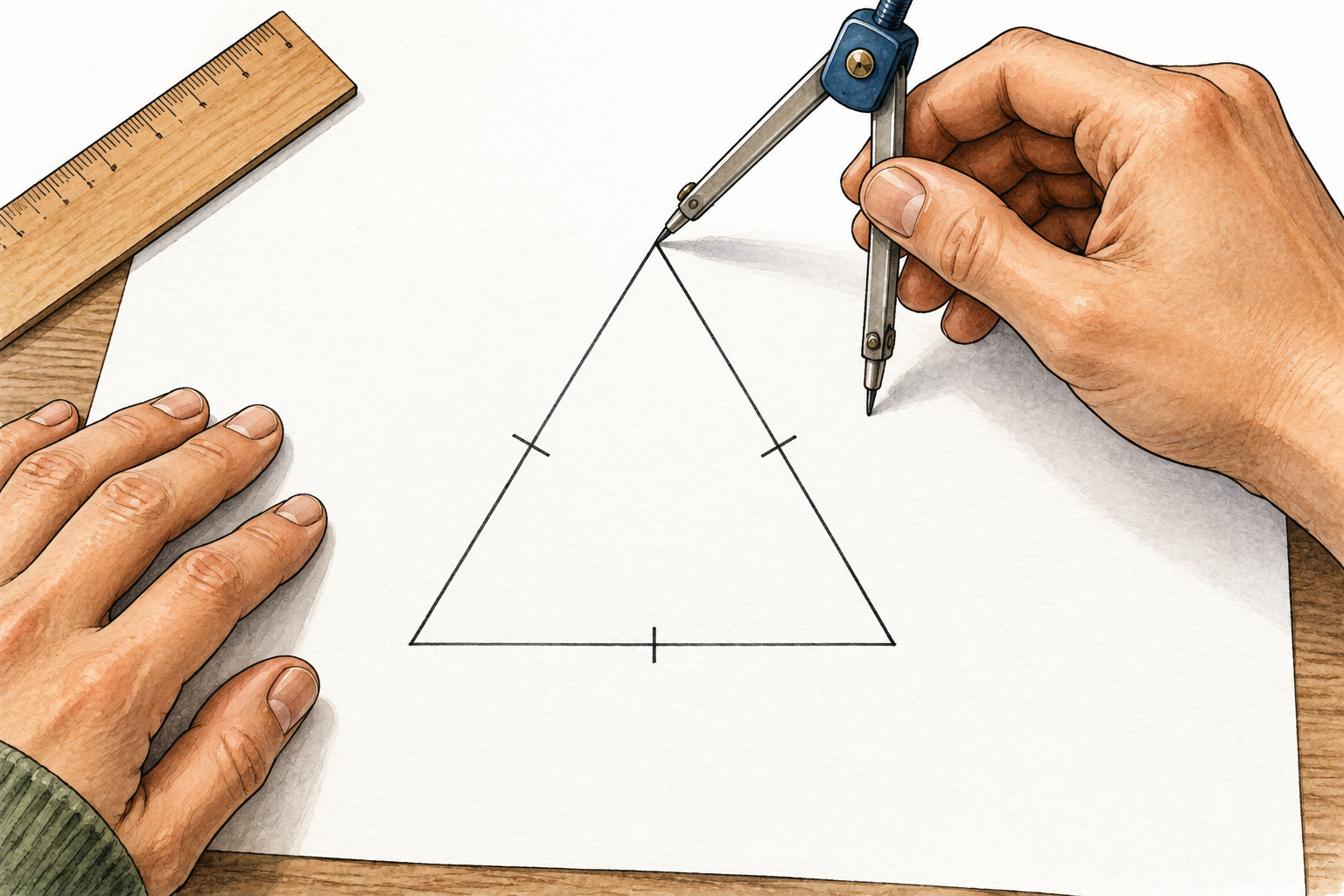
A precise equilateral triangle drawn with ruler and compass on plain paper, one identical short tick mark at midpoint of each of its three equal sides, no words or numerals.
Etymology

The side root also meant the flank of a person or animal. Combined with “equally,” it describes a figure whose sides all match in length.

In context

Curt Jaimungal41:06
That's, I think, how one should think about size. Then you can say, which is the smallest triangle? Well, it's the equilateral triangle because all sides are equal.
The Physicist Who Says Time Doesn't Exist

More examples

  • She draws an equilateral triangle with a ruler and compass.
  • Every square is equilateral, since its four sides are equal.
  • The worksheet asks us to identify the equilaterals among several triangles.

Forms

equilateral · equilaterals

Similar words

regular
Requires equal angles as well as equal sides in polygons.
isosceles
Describes triangles with at least two equal sides, not necessarily three.