DictionaryRoot: -alis
Latin

-alis

of, relating to

Forms

  • -alis
  • -aris — Latin variant especially used when the stem already contained l, avoiding a repeated l sound.
  • -al — English ending borrowed through French or directly from Latin.
  • -ar — English ending continuing Latin -aris.

Origin

An older Latin adjective-forming suffix; its more remote ancestry is uncertain.

Note

Expresses a relationship without specifying its kind: material, place, purpose, and other connections are possible.

195 / 291
adjective

parietal

puh-RYE-uh-tul/pɝˈaɪʌtʌl/

Relating to the wall of a body cavity or organ.

The highlighted parietal bone forms part of the skull's protective wall.
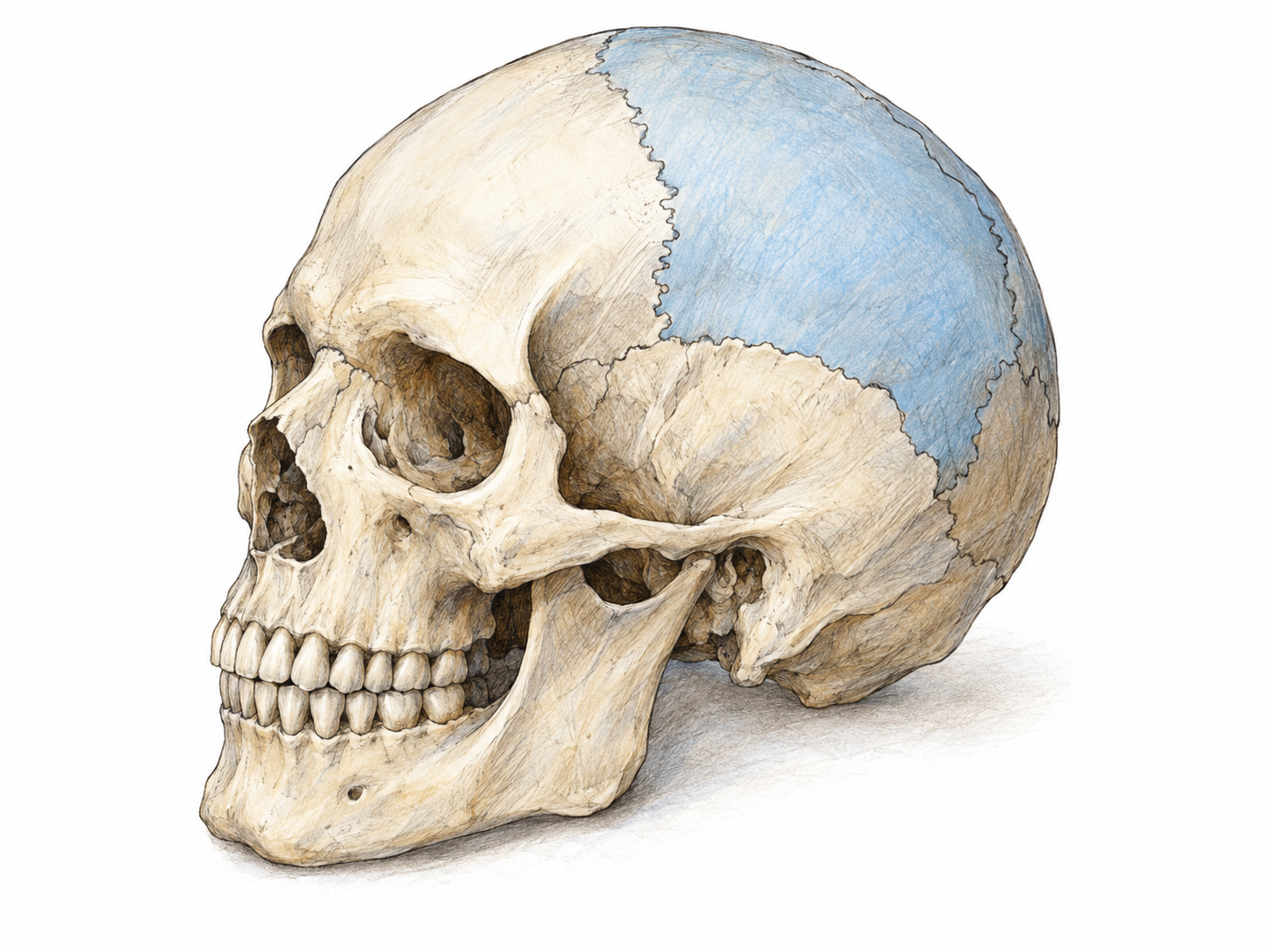
A single anatomically accurate adult human skull in three-quarter lateral view, with the visible parietal bone subtly tinted to emphasize the bone forming the upper side of the skull.
Etymology

The literal idea is “relating to a wall.” In anatomy, the wall is the enclosing boundary of a body cavity, including the bones forming the sides of the skull.

In context

Academy of Art University38:11
I'm coming down now to the angle where the skull begins to change from top to side there is the parietal edge
Sculpture Demonstrations and Interviews with Eugene Daub | Academy of Art University

More examples

  • The parietal peritoneum lines the inner wall of the abdomen.
  • The scan shows thickening of the parietal pleura.
  • The parietal pericardium lines the inside of the fibrous sac around the heart.

Similar words

mural
Also describes organ walls, especially those of the heart.